JCBTech / Services / Development
[ Service ]

Development.

Adapting to change. Converting ideas into applications.

Turning concepts into high-performing solutions.

Development is the process of growth and progress — turning concepts into practical, high-performing solutions. JCBTech specialises in control system development, guiding you through every stage from process improvement to cutting-edge technology integration.

sdlc · iteration · validation

Development Principles

In control system design, development is about creating, testing, and refining systems to meet precise performance goals. This involves building models, designing controls, and validating them through simulation and real-world testing.

  • Analysis. Studying system behaviour to identify improvement areas.
  • Design. Developing models and controls to enhance performance.
  • Simulation. Testing and refining designs in a virtual environment.
  • Real-world testing. Validating performance under actual conditions.
model-based · HIL · prototyping

Development Methods

We employ a range of proven methods to deliver robust control systems, tailored to your needs.

  • Model-based design. Mathematical models simulate and design systems before implementation.
  • Iterative design. Refining systems through multiple cycles based on test feedback.
  • Co-simulation. Simulating control and physical systems together for accuracy.
  • Rapid prototyping. Quickly building and testing prototypes to catch issues early.
  • Hardware-in-the-loop. Evaluating systems on physical prototypes in real conditions.
  • Simulation-based optimisation. Fine-tuning parameters through iterative simulations.
llm · sd-card deployment

Case Study — Local LLM for Automation

JCBTech developed an advanced Large Language Model system to enhance automation workflows. Designed to run locally and deployed easily from an SD card, this solution ensures proprietary data remains secure while delivering AI capabilities to control systems.

  • Analysis. Defined NLP requirements, PLC integration, real-time responsiveness — prioritising local execution for security.
  • Model-based design. Simulations modelled the LLM’s interaction with industrial protocols, ensuring secure data handling.
  • Rapid prototyping. Early SD-card prototypes tested language comprehension and system compatibility.
  • Co-simulation. Validated alongside simulated factory setups, confirming performance without external data exposure.
  • Optimisation. Iterative simulations fine-tuned efficiency, reducing latency while maintaining robust local operation.
Visit JCBTech Assistant
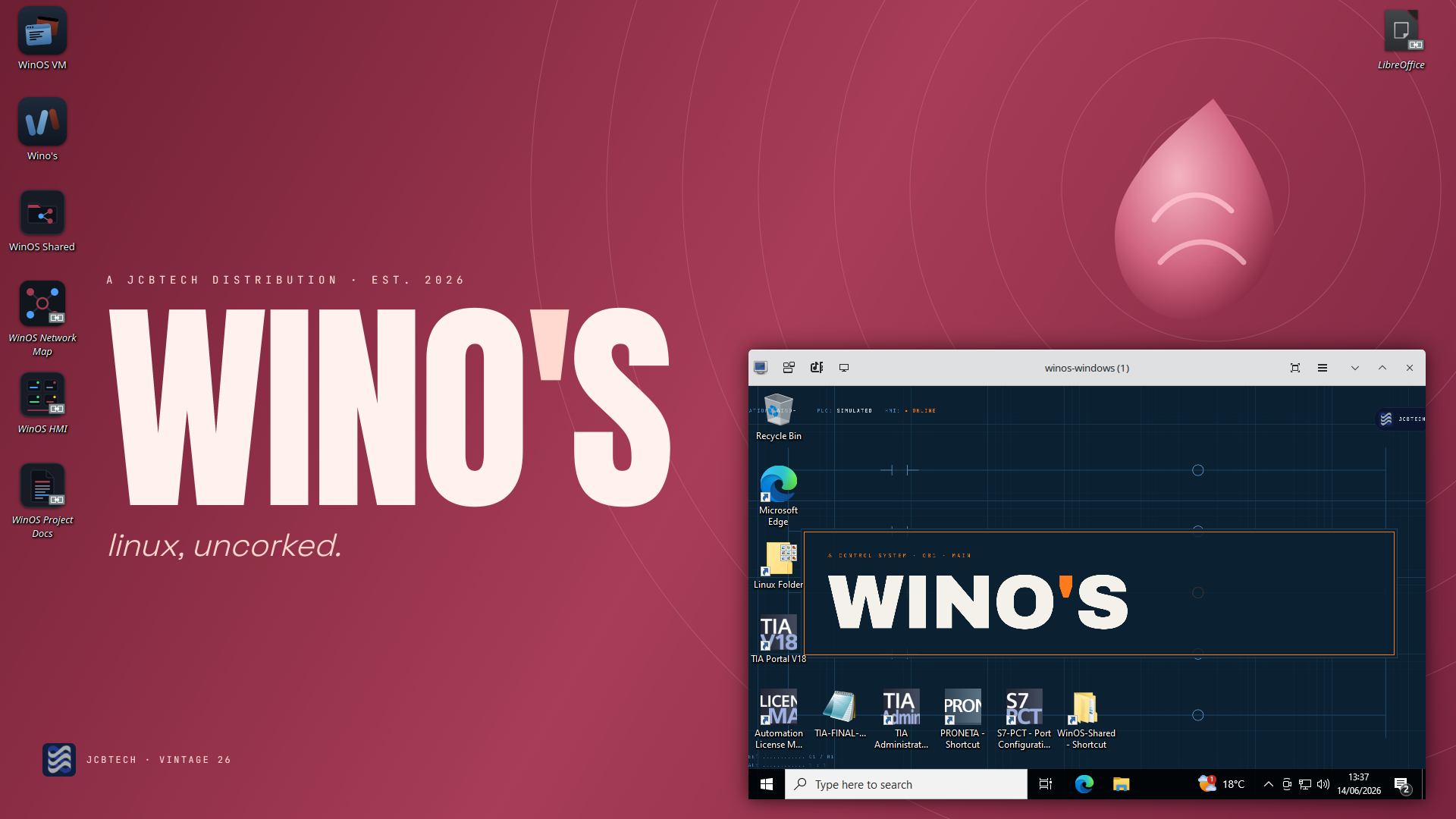
Wino's desktop — a JCBTech Linux distribution running TIA Portal in a virtualised Windows environment

Case Study — Wino's: AI-Native Engineering OS

Wino's is a purpose-built Linux operating system that places a locally-run language model in direct command of industrial engineering software. It bridges a native Linux AI environment to Siemens TIA Portal, letting an engineer drive PLC programming and project work through natural language — entirely on-premises, with no proprietary data leaving the machine.

  • Architecture. A local LLM on Linux communicates with TIA Portal running in a virtualised Windows environment, through a purpose-built bridge service exposing engineering functions as structured tools.
  • TIA Openness integration. Deep integration with the Siemens TIA Openness API gives the assistant programmatic control of projects — creating, reading, importing and compiling program blocks under instruction.
  • Closed-loop programming. The assistant writes control logic in SCL, compiles it, reads the compiler feedback, and iterates on its own errors — the same refine-until-correct cycle an engineer follows in the editor.
  • Version-aware. Designed to operate across multiple TIA Portal versions, switching engineering environments on demand while presenting a single, consistent toolset.
  • Secure by design. Local-first execution keeps source code, project data and intellectual property entirely within the engineer's own infrastructure.

Wino's reframes the engineering workstation: instead of an operator navigating menus, an assistant carries out high-level intent — from scaffolding a new project to diagnosing a block — while the engineer stays in control of every step.